
Aboriginal Malays (Orang Asli) began moving down the Malay peninsula from south-western
China about 10,000 years ago. The peninsula came under the rule of the Cambodian-based
Funan, the Sumatran-based Srivijaya and the Java-based Majapahit empires, before the
Chinese arrived in Melaka in 1405. Islam arrived in Melaka at about the same time and
spread rapidly. Melaka's wealth soon attracted European powers, and the Portuguese took
control in 1511, followed by the Dutch in 1641. The British established a thriving port in
Penang in 1786 and took over Melaka in 1795.
 The British
colonised the interior of the peninsula when tin was discovered. East Malaysia came into
British hands via the adventurer Charles Brooke (who was made Rajah of Sarawak in 1841
after suppressing a revolt against the Sultan of Brunei) and the North Borneo Company
(which administered Sabah from 1882). Britain took formal control of both Sabah and
Sarawak after WWII. The indigenous labour supply was insufficient for the needs of the
developing rubber and tin industries, so the British brought large numbers of Indians into
the country, altering the peninsula's racial mix. The British
colonised the interior of the peninsula when tin was discovered. East Malaysia came into
British hands via the adventurer Charles Brooke (who was made Rajah of Sarawak in 1841
after suppressing a revolt against the Sultan of Brunei) and the North Borneo Company
(which administered Sabah from 1882). Britain took formal control of both Sabah and
Sarawak after WWII. The indigenous labour supply was insufficient for the needs of the
developing rubber and tin industries, so the British brought large numbers of Indians into
the country, altering the peninsula's racial mix.
 The
Japanese overran Malaya in WWII. Communist guerrillas, who fought the Japanese throughout
the occupation, began an armed struggle against British rule in 1948 and Malaya achieved
independence in 1957. Sabah, Sarawak and Singapore combined with Malaya to establish
Malaysia in 1963, but two years later Singapore withdrew from the confederation. The
formation of Malaysia was opposed by both the Philippines and Indonesia, as each had
territorial claims on The
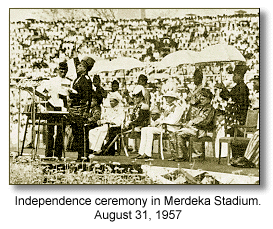
Japanese overran Malaya in WWII. Communist guerrillas, who fought the Japanese throughout
the occupation, began an armed struggle against British rule in 1948 and Malaya achieved
independence in 1957. Sabah, Sarawak and Singapore combined with Malaya to establish
Malaysia in 1963, but two years later Singapore withdrew from the confederation. The
formation of Malaysia was opposed by both the Philippines and Indonesia, as each had
territorial claims on  East Malaysia. East Malaysia.
 Tension
rose in 1963 during the 'Confrontation' with Indonesia. Indonesian troops crossed
Malaysia's borders but were repelled by Malaysian and Commonwealth forces. In 1969,
violent riots broke out between Malays and Chinese, though the country's racial groups
have since lived in relative peace together. The United Malays National Organisation
(UMNO) has been in power since 1974. Prime Minister Dr Mahathir Mohamad, who is keen to
exert his influence on the world stage as a pan-Asian leader, presided over a booming
economy until 1997, when tumbling Asian currencies dragged the ringgit down with them. Tension
rose in 1963 during the 'Confrontation' with Indonesia. Indonesian troops crossed
Malaysia's borders but were repelled by Malaysian and Commonwealth forces. In 1969,
violent riots broke out between Malays and Chinese, though the country's racial groups
have since lived in relative peace together. The United Malays National Organisation
(UMNO) has been in power since 1974. Prime Minister Dr Mahathir Mohamad, who is keen to
exert his influence on the world stage as a pan-Asian leader, presided over a booming
economy until 1997, when tumbling Asian currencies dragged the ringgit down with them.
 In
September 1998 the country hosted the Commonwealth Games, but the public relations aspect
of the competition came apart when students and citizens protested against the unfair
sacking and later imprisonment of deputy Prime Minister, Anwar Ibrahim. Continuing street
protests,calling for the resignation of Dr Matahir Mohamad, have unsettled Malayasia's
reputation as one of the most politically stable of South-East Asian countries. By the
time the 21st century rolled around, social upheavals had faded to a distant rumble and
the Malaysian economy had clawed its way back into the game, 'tho it remains a little proppy. In
September 1998 the country hosted the Commonwealth Games, but the public relations aspect
of the competition came apart when students and citizens protested against the unfair
sacking and later imprisonment of deputy Prime Minister, Anwar Ibrahim. Continuing street
protests,calling for the resignation of Dr Matahir Mohamad, have unsettled Malayasia's
reputation as one of the most politically stable of South-East Asian countries. By the
time the 21st century rolled around, social upheavals had faded to a distant rumble and
the Malaysian economy had clawed its way back into the game, 'tho it remains a little proppy.
|


